Engagement & leadership
What does the Gallup Engagement Index 2025 tell us?
The Gallup Engagement Index describes the emotional attachment of employees in Germany to their employer. It provides a reason to look more closely at conditions in your own company; it does not diagnose your team. To make a decision, you also need your own observations, relevant feedback and a specific initiative.
Here you will find the key figures from the 2025 report and an independent practical interpretation for senior management, HR and department heads. The focus is on what you can reasonably take from a general finding — and which conclusions go too far. The article on employee engagement explains how the general concept differs from satisfaction and attachment.
What does the Gallup Engagement Index Germany 2025 show?
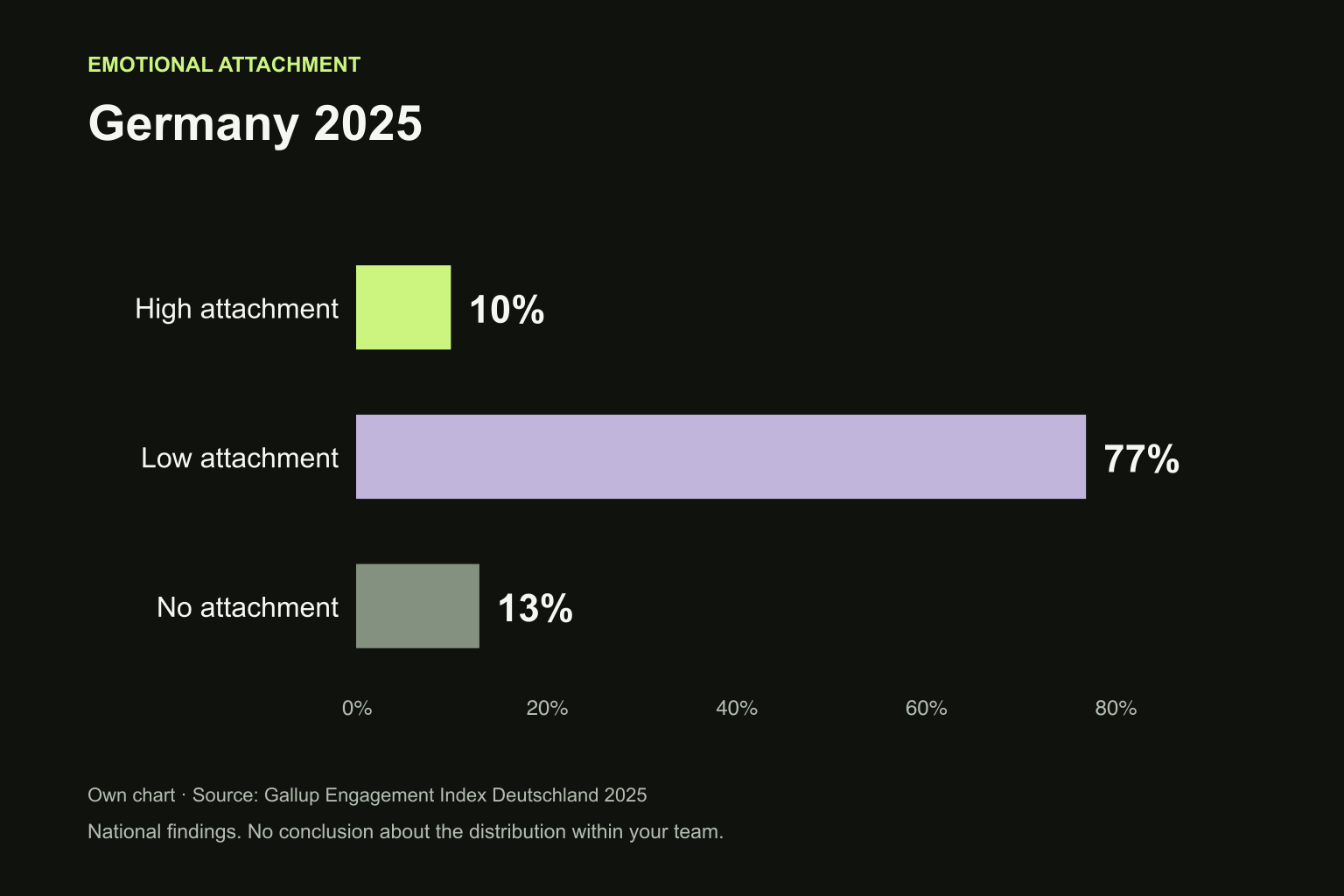
The original Gallup report, published in March 2026, gives the following distribution of emotional attachment for 2025:
| Emotional attachment | Share of employees |
|---|---|
| High | 10 % |
| Low | 77 % |
| None | 13 % |
According to Gallup’s methodology, 1,700 randomly selected employees aged 18 and over were interviewed by telephone between 17 November and 20 December 2025. Gallup describes the findings as representative of employees in Germany aged 18 and over.
The figures relate to the 2025 survey. They are not an ongoing measurement for October 2026. The chart on this page is our own presentation of the published proportions, not an extract from a Gallup dashboard.
What do these figures tell us about our own team?
Initially, they tell you nothing specific about the distribution in your company. A nationwide proportion cannot simply be applied to a team. If you have ten people in an office, you therefore cannot infer how many are highly attached or emotionally detached. Such a calculation would turn a statistical description into an unsupported claim about people.
Nor does the report establish a particular reason for your situation. Perhaps development and collaboration work well, while work planning causes problems. Perhaps trust is high, but someone leaves for personal reasons. To make an appropriate decision, you need to look at your own working environment.
Use the study as a starting point for questions: which conditions support good work here? Where do recurring obstacles get in the way? What evidence do we already have? This gives the report a practical role without attributing a national distribution to your own team.
How does this become a question of business relevance?
For senior management, a general attachment rate is not yet a mandate to invest. Connect an observed problem to a specific business context: where does avoidable rework arise? Which decisions delay customer projects? Where is planning certainty or knowledge lacking? Describe the process first, before promising a financial amount or a successful outcome.
Fictional example: A company loses time because tasks are handed over repeatedly between two departments. Employees express frustration, and customers receive conflicting commitments. The first initiative is therefore to establish clear responsibilities for handovers. It is not to reach the nationwide engagement figure.
An assessment needs to consider both the effort involved in an action and its observed consequences. Record the time spent on preparation and implementation, and the business measure you want to review afterwards. An improvement in mood can be a relevant indication. However, it cannot be converted into euros saved without further evidence.
Likewise, an economy-wide estimate from a study should not be scaled down to your own revenue. Your workflows, costs and scope for influence need to be considered separately. This prevents an impressive figure from disguising an uncertain business case.
What questions should leaders and HR ask now?
Start with observable working conditions. The following statements are our own suggestions for brief feedback on a specific initiative. They neither reproduce Gallup’s questionnaire nor produce a Gallup score.
| Reason | Our example question | What the response helps you assess |
|---|---|---|
| Conflicting tasks | This week, I was clear about which tasks took priority. | Review priorities and decision-making practices. |
| Stalled handovers | I had the information I needed for my tasks. | Review the flow of information within the workflow. |
| An unclear change | I understand what the new rule changes for my work. | Review communication and implementation. |
| A new action | The agreed change made my work easier this week. | Review the perceived effect of the specific step. |
A response scale from 1 “strongly disagree” to 5 “strongly agree” can make comparisons over time easier. Offer an option to skip a statement when it does not apply. This is needed, for example, when someone has not yet worked with the new rule. A missing value is then more honest than a forced rating.
Do not ask people to demonstrate blanket enthusiasm. Employees should be able to describe their work situation. Trying to infer individuals’ loyalty from their responses changes the purpose of the survey. The article on measuring employee satisfaction provides guidance on questions and analysis.
How do you turn the study into a specific initiative?
First agree on a shared starting question. Senior management, HR and the responsible manager should want to address the same problem. Otherwise, one party expects an attachment rate, another a list of priorities, and the team a new working rule. These differences need to be clarified before the first question is asked.
Then record which decision depends on the feedback. A useful statement might be: “If handovers are regularly experienced as incomplete, we will revise responsibilities and minimum information requirements.” This gives the survey a purpose beyond collecting data.
Choose a manageable action and assign a person responsible for it. Set a review point that fits the actual rhythm of the work. Frequent handovers allow earlier observations than infrequent customer appointments. A fixed period for every topic would suggest a level of precision that the process cannot support.
Then tell the team which observation led to the decision, what exactly will change and what remains open for now. The article on employee retention shows how possible actions can be organised by working conditions.
How can you meaningfully review the effect of a change?
First check whether the action was implemented as agreed. A rule that has only been announced is different from one that is reliably followed in everyday work. Then look at how employees experience the situation and whether relevant business observations change.
Keep the question, scale and reference point as stable as possible. Also compare participation and team composition. A more favourable average may arise because different people responded or because the week was unusually quiet. Such changes deserve particular attention in small groups.
A trend alone does not prove a cause. Look for a plausible connection between the change and the result, and take other events into account. An appropriate statement might be: “The feedback and fewer follow-up questions support keeping the new handover process.” This is different from a reliably calculated financial return.
If nothing improves, start with a factual review: was the problem defined correctly? Was the action actually used? Does the question fit the initiative? The article on analysing an employee survey helps with the transition from results to next steps.
Which conclusions should we avoid?
Do not confuse emotional attachment, satisfaction, weekly mood and actual departures. These concepts are related in everyday work, but they ask different questions. A weekly question you write yourself therefore cannot be converted into the categories of the Gallup Engagement Index.
Do not use the figures to judge individual employees or rank small teams, either. Protection thresholds, access rules and clear information belong in the preparation. Clarify the conditions with the responsible people in your organisation; the information on confidentiality and employee co-determination offers initial guidance.
This article is an independent interpretation. EngageBeat is not part of Gallup, and its team index is not a Gallup test. Gallup and Q12 are trademarks of Gallup. The linked original report is the authoritative source for the full findings and methodology.
What questions are frequently asked about the Engagement Index?
Is the Gallup Engagement Index a benchmark for our team?
It describes a national finding. Your own team figure can only be meaningfully interpreted using a comparable method and suitable comparison groups. A weekly mood figure is not directly comparable.
Can we calculate the Gallup categories from our own scale?
No. Your own question with a scale from one to five does not provide a reliable classification into Gallup’s categories. Describe precisely what your question actually captures.
Which metric should we monitor after an action?
Choose feedback on the specific change and supplement it with a relevant business observation. Also record whether the action was implemented. A single overall figure is not enough to interpret the results.
How does EngageBeat support the next steps?
EngageBeat helps you keep a regular view of mood and motivation and gather feedback on specific changes. This allows you to identify where action is needed earlier, initiate appropriate steps and continue observing their perceived effect. Custom questions in EngageBeat Fokus can accompany a specific initiative.
This does not replace scientific engagement assessment or individual performance appraisal. If you are looking for a regular overview for your team, explore employee surveys with EngageBeat and the public demo. The trial page explains how setup and getting started work.
Sources and further background
Try it in your team
Complement your view of studies with regular feedback from your own teams.
Try free for 28 days — with up to three teams. Can be ended at any time during the trial.
All terms