Engagement & leadership
Employee engagement: Meaning, influencing factors and actions
Employee engagement describes how much people involve themselves in their work and feel connected to it. It is not the same as satisfaction, a good mood on a particular day or the intention to stay with the company. To encourage engagement, examine working conditions and obstacles rather than drawing conclusions about individuals' attitudes from a single value.

For senior management and HR, the topic matters when committed people are held back by unclear decisions, missing resources or conflicting expectations. This article puts the terms and possible starting points in context. It provides neither a method for assessing individual employees nor a promise that a survey alone will change the situation.
What is meant by employee engagement?
In day-to-day business, employee engagement often means several things at once: motivation, connection, participation and willingness to contribute. As a result, the same term may mean something different in two surveys. Before collecting a value, decide which experience or goal actually interests you.
The CIPD factsheet on engagement and motivation distinguishes the broad business term from the more narrowly defined concept of work engagement in occupational psychology. The latter describes, among other things, energy and dedication at work. The overview also warns against mixing different concepts and possible influencing factors into an overall value that is difficult to interpret.
For a specific decision, “What is currently preventing meaningful work?” is therefore often more accessible than “How engaged are our employees?”. The first question directs attention to conditions that can be changed. Without a clear definition, the second can easily become a sweeping judgement.
How do engagement, satisfaction, motivation and retention differ?
These terms are connected in everyday use, but answer different questions. Keeping them separate helps you choose suitable actions rather than responding to every critical piece of feedback with the same motivation programme.
| Term | What is it about? | What cannot be inferred from it alone? |
|---|---|---|
| Satisfaction | How someone assesses their work situation. | Whether the person currently has the energy for a new task. |
| Motivation | What drives someone to take a particular action. | Whether their attachment to the company will last. |
| Engagement | How involved and connected people feel in their work. | How much an individual actually achieves. |
| Retention | The relationship with the employer and whether people stay. | Whether day-to-day work feels meaningful and open to influence. |
Satisfaction
- What is it about?
- How someone assesses their work situation.
- What cannot be inferred from it alone?
- Whether the person currently has the energy for a new task.
Motivation
- What is it about?
- What drives someone to take a particular action.
- What cannot be inferred from it alone?
- Whether their attachment to the company will last.
Engagement
- What is it about?
- How involved and connected people feel in their work.
- What cannot be inferred from it alone?
- How much an individual actually achieves.
Retention
- What is it about?
- The relationship with the employer and whether people stay.
- What cannot be inferred from it alone?
- Whether day-to-day work feels meaningful and open to influence.
Someone may like their colleagues and still have doubts about a project. Another person contributes intensively but is considering leaving because development opportunities are missing. Neither fits a simple label such as “satisfied means engaged”.
Separate articles on employee satisfaction and employee retention explore each in more detail. The questions described there should not be combined into an engagement scale without checking their suitability.
What might cause low engagement in day-to-day work?
Start with the work situation rather than an assumed personality trait. For example, tasks may seem important while the resources to carry them out are missing. Or employees are expected to take responsibility while every small decision is overturned. These contradictions can be addressed more concretely than an appeal to contribute more.
Practical areas to explore include clarity about the task, room to make decisions in practice, accessible support and the experience that feedback leads to something. These are starting points for investigation, rather than a complete explanation for every team or a scientific engagement test of our own.
In work design, the UK's Health and Safety Executive, HSE, distinguishes demands, control, support, relationships, role and change, among other aspects. These six areas provide an additional way to organise working conditions. They are neither an engagement scale nor legal guidance for German businesses.
Ask in each area: What can we actually change here? A team can reorganise handovers. A vacant position or conflicting company goals may require a decision from senior management. Responsibility must not land with the team when the cause lies outside its control.
Which questions help you understand the situation more precisely?
Separate the experience of work from possible causes. “This week, I could concentrate on a meaningful task” describes a different experience from “I knew which task took priority”. If you ask both, discuss the results separately too.
Our own example questions to get started are:
- Which tasks have recently allowed you to contribute well?
- Which recurring obstacle makes meaningful work more difficult for you?
- Where do you need a decision that you cannot make within the team?
- Which previously agreed change has reached day-to-day work?
These open questions are examples for conversation and investigation, rather than a validated questionnaire. Recurring scale questions need unambiguous wording and a suitable period. A short pulse survey can regularly revisit selected experiences; it does not thereby automatically measure employee engagement in full.
Also allow room for “I cannot assess this”. Not everyone experiences every point of contact or change. A forced middle response would mix a lack of experience with an assessment of the issue itself.
Which actions are more useful than a general appeal for motivation?
Choose a change whose effect can become visible in day-to-day work. If priorities change daily, an additional recognition initiative may be pleasant, but it does not resolve the contradiction. A firm decision about what can be left undone this week addresses the obstacle more directly.
| Observed obstacle | Possible trial | How the team might notice a change |
|---|---|---|
| Too many simultaneous tasks | Set a shared sequence with clear exceptions. | Fewer unresolved priority changes. |
| Decisions remain pending | Agree who is responsible and a deadline for the decision. | Fewer blocked work steps. |
| Feedback disappears | Report the next step back for every issue taken up. | Clarity about what is happening and what remains open. |
| Tools are missing | Remove a specific bottleneck and check use. | The previous workaround is needed less often. |
Too many simultaneous tasks
- Possible trial
- Set a shared sequence with clear exceptions.
- How the team might notice a change
- Fewer unresolved priority changes.
Decisions remain pending
- Possible trial
- Agree who is responsible and a deadline for the decision.
- How the team might notice a change
- Fewer blocked work steps.
Feedback disappears
- Possible trial
- Report the next step back for every issue taken up.
- How the team might notice a change
- Clarity about what is happening and what remains open.
Tools are missing
- Possible trial
- Remove a specific bottleneck and check use.
- How the team might notice a change
- The previous workaround is needed less often.
The suggestions are possibilities, rather than guaranteed solutions. Check with those affected whether your assumption is correct and decide who will implement the change. A list of good intentions without available time, responsibility and scope to decide changes little.
What might this look like in a specific team?
A fictional example: a technical project team is working on an important new development. Those involved see the initiative as meaningful but experience little progress. Feedback reveals that approvals are repeatedly missing, so work has to be started several times.
The team does not initially need a campaign for more enthusiasm. The department head agrees on a fixed approval date and names a deputy. The team records which work steps remain blocked afterwards and how reliable it finds the decisions.
After some time, both perspectives are considered together: Did the process work, and did it make the work less contradictory? If so, there is a reason to continue with the change. If not, the explanation needs adjusting. An improved survey value alone would not yet be evidence of a financial effect.
How can you check progress without assessing individuals?
Follow the agreed change and its consequences at the appropriate level. This includes implementation itself, recurring feedback and operational information already available. These perspectives should remain distinguishable; they do not automatically form a combined engagement score.
A short trend needs particularly cautious interpretation. Different orders, a staff change or a quieter period may affect perceptions. Look for recurring patterns and counterexamples. Ask explicitly what remains difficult despite the action.
Avoid rankings and the assumption that low values indicate a lack of effort. A critical team may identify important obstacles more clearly than an apparently satisfied one. High survey participation does not prove high engagement either: it initially shows that people responded.
What role do trust and feedback play?
People responding openly should know in advance who can see the results and what they will be used for. A team review must not turn into a search for individual respondents. Recognisable comments and small groups need particular care. The Confidentiality page describes how EngageBeat defines its framework for this.
Honest feedback about limits is equally important. If a desired change is not currently possible, explain the decision and the next review date. This is more helpful than turning every piece of feedback into a vague “we'll take that on board”. The article on actions after employee surveys explains how results become specific next steps.
Where can EngageBeat help here?
EngageBeat can make selected experiences from the team's day-to-day work visible through short weekly check-ins. The team index is not a validated engagement index and does not assess individuals. For HR, the format can provide additional feedback on how agreed changes are being experienced.
What it looks like in the app
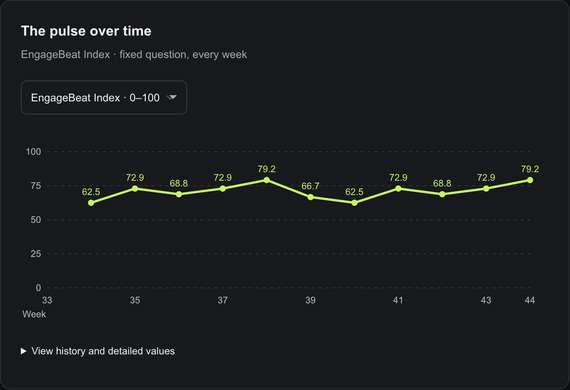
A team signal is not yet an engagement index
The EngageBeat Index summarises the fixed collaboration question. Its trend does not provide a complete measurement of employee engagement or, on its own, demonstrate an action's effect.
Enlarge screenshot
What questions are frequently asked about employee engagement?
Is employee engagement the same as motivation?
No. Motivation describes the drive behind actions. Engagement means involvement and connection at work; its precise meaning must be clarified before an investigation.
Does high satisfaction automatically mean high engagement?
No. A positive assessment of the work situation alone does not show how involved people feel in their current task. Both perspectives should be considered separately.
Does a question about mood measure all engagement?
No. It captures a limited perception. Without an appropriate methodological basis, a team index or short pulse survey is not a complete engagement instrument.
What is a useful first action?
Choose a specifically described obstacle, check the explanation with the team and agree on a feasible change with responsibility and a review.
Is engagement suitable for ranking individuals?
The feedback described here is not intended for that purpose. It is meant to clarify working conditions and shared next steps, rather than justify individual assessments.
Sources and further background
Try it in your team
Try EngageBeat to see how selected feedback on working conditions relates to agreed changes.
Try free for 28 days — with up to three teams. Can be ended at any time during the trial.
All terms