For Executive management
Support multiple teams with feedback
By the time friction shows up in an annual survey, an exit interview or a resignation, some issues may already be entrenched. EngageBeat helps you notice developments in teams earlier and support appropriate action in everyday work.
Try free for 28 days — with up to three teams. Can be ended at any time during the trial.
All termsView organisation-wide analysis in the demo ↗
With three or more teams set up together, you can see the aggregate results for your department — without individual team results or rankings. Available during the trial if three teams start together. This requires assignment to the same department, sufficient participation and compliance with the privacy safeguards after the week closes.

What delayed feedback means for your organisation
Unclear priorities, stalled decisions or difficult collaboration rarely cause an obvious breakdown straight away. At first, coordination takes longer, issues remain unresolved and employees withdraw. If you only hear about this months later, the original trigger is often difficult to reconstruct. An annual survey can provide useful insights, but the opportunity for a small, early correction may have passed.
A weekly check-in shortens the gap between everyday work experiences and deliberate reflection. It does not explain every change or predict resignations. It creates a regular opportunity to look more closely: Which priority is unclear? Where is a decision missing? Which agreed action needs support? What matters is whether feedback leads to clear steps and whether you later check if they help.
Annual surveys and weekly check-ins complement each other
The two formats answer different questions. An annual survey can cover many topics at the same point in time. EngageBeat focuses on a short cycle of two to four questions per week. The comparison below describes typical uses, not guaranteed outcomes. In both formats, scope, participation and question quality determine how meaningful the results are.
Response time
Annual survey
One agreed survey date; developments in between need other feedback channels.
Weekly check-in
Recurring signals; results after the week closes, not in real time.
Effort
Annual survey
More topics require time for preparation, participation and analysis.
Weekly check-in
A few questions per week; setup, interpretation and action remain the responsibility of those in charge.
Connection to action
Annual survey
Suitable for broader initiatives, provided responsibilities and follow-up are clear.
Weekly check-in
Close to everyday work; specific changes can be discussed repeatedly.
What the results can tell you
Annual survey
A broader picture of topics at a particular point in time, depending on design and participation.
Weekly check-in
Trends across a small number of questions; context and participation must be considered alongside them.
Limitations
Annual survey
A single point in time gives only a limited view of developments in between.
Weekly check-in
No complete diagnosis or proof of causes; results require at least five valid responses per question.
Introducing multiple teams: agree the framework before the rhythm
Start with a manageable group of suitable teams. Assign someone responsible at organisation level and the relevant people in each team. Clarify which decision or change you want the feedback to support. Also agree how team leads will share results with their teams and which wider obstacles they may escalate to you. This does not automatically give executive management access to all team data.
Before the first live check-in, clarify data protection, co-determination where applicable, participant information and access rights. This also includes the data processing agreement and a deliberate choice of retention period. Fixed volume pricing is available for up to ten teams; for eleven or more teams, or personal support, we prepare an individual quote. Up to three teams can try the product free for 28 days on their first shared start date. Additional teams or teams starting later require an explicit paid booking. Personal support is agreed separately. An Enterprise enquiry therefore does not start a trial or constitute a blanket commitment to an organisation-wide package.
Plan the timeline in three stages. Preparation comes first; its duration depends on your internal approvals. You then set up access and the weekly rhythm. The 28 days begin when the first survey opens. Setup and preparation do not count towards the trial. This is followed by a joint review of the agreed trial and a decision on the wider rollout. We cannot commit to a fixed rollout date without this coordination.
Most of the organisational work involves the rollout and responding to results. A central contact coordinates documents and decisions; team owners set up their teams, check invitations and reminders, review released results and support agreed actions. The short time participants need to answer is not the full workload for the team lead. Our recommendation: set aside a recurring discussion within your existing team rhythm rather than building an additional reporting process.
What you get — and what is deliberately excluded
EngageBeat shows a fixed team index and separate trends for the topics surveyed. Team results and comments are visible only to authorised team owners: after the survey week closes and only when there are at least five valid responses per question. Participant access does not include results. Employees do not need a personal account to participate; response records contain no names or email addresses.
The tool provides no individual analysis, performance assessment or ranking of people. A falling index explains neither its cause nor who might be responsible. Comments, small groups and contextual knowledge can still allow individuals to be identified. We therefore do not promise absolute anonymity. With shared access, five valid responses are also not technical proof that five different people responded.
Organisation-level reporting is available at no extra cost from 3 teams in EngageBeat Team, EngageBeat Fokus and EngageBeat Enterprise, and is set up optionally. If three teams begin on the first shared start date, you can also try organisation-level reporting during the trial. It complements the team views: authorised people see a combined index and comparable topic trends after the week closes. For each question, results must be released for at least three teams, each with at least five valid responses; additional protection rules may suppress values. Comments and individual team values are not displayed. Authorised company admins or organisation leads set up inclusion; team owners are informed. The assignment takes effect from the following Monday; existing weeks are not included retrospectively. SSO, integrations and personal support require separate agreement.
Access and limitations in detail
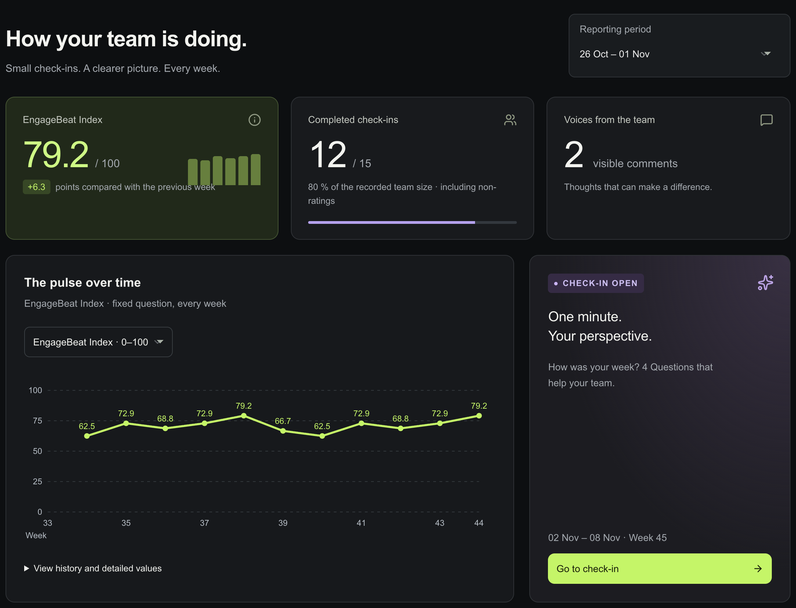
The team view: understand feedback within each team
The demo shows the released team index, participation and comments from an example team. Authorised team owners have access; an executive role does not automatically provide access to other teams.
From a signal to an action you can review
Use a notable result as a starting point for a factual discussion. Then agree a specific change, a responsible person and a time to review it. For unclear priorities, this could be shared weekly planning; for stalled handovers, clear ownership. Repeated feedback helps you observe whether the perceived problem changes.
The trend alone does not prove a cause or the economic benefit of an action. New tasks, absences or changes in team composition may also affect the picture. Record what you actually changed and consider the feedback alongside the working context.
Optional support from Sven Heese
Sven Heese can support your rollout, facilitate discussions and help integrate EngageBeat into an organisational development process. This may be useful when several teams have different starting points or when shared findings need to become concrete decisions. Objectives and scope are agreed with you; this support is not automatically included in EngageBeat Team or EngageBeat Fokus.
In a conversation, you can describe your reasons for starting, the teams involved and any unresolved requirements. We will help clarify the right starting point. You can find more about Sven and his professional background under ‘About us’.
Questions before getting started
Does EngageBeat replace our annual survey?
No. The short weekly rhythm complements a broader survey. It helps you follow current developments and agreed actions. It does not automatically cover every topic in an annual survey or provide a complete organisational diagnosis.
Can executive management review all teams centrally?
Yes, through separately configured organisation access. Organisation-level reporting is available at no extra cost from 3 teams in EngageBeat Team, EngageBeat Fokus and EngageBeat Enterprise, and is set up optionally. If three teams begin on the first shared start date, you can also try organisation-level reporting during the trial. It shows aggregated values after the week closes, not comments or individual team values. Each question requires at least three teams with released results, each with at least five valid responses; further protection rules apply. Authorised company admins or organisation leads set up inclusion from the following Monday; team owners are informed. An executive management role alone does not grant access.
How quickly can multiple teams start?
That depends on your approvals, documents and setup. Preparation does not count towards trial time. You can prepare teams and invite the people responsible for them. Organisational units are optional; they are not required for standard team creation. Up to three teams receive 28 free days on the first shared start date; later or additional teams start only after an explicit paid booking. A company admin confirms the booking and start in the web app.
What does EngageBeat Enterprise cost?
When six to ten teams have actually started and have not yet ended, the lower pricing tier applies to each team from its next billing period. Planned teams do not count. For eleven or more teams, and for personal support, we agree an individual quote. Team size alone does not require an individual plan; the minimum team size is five people. ‘Request an individual quote’ lets you describe your needs; it does not automatically create a paid subscription.
Is a conversation required before every trial?
A conversation is optional for a standard single-team booking. An individual organisation-wide offer requires agreement on scope and conditions. We will agree with you how to handle this; no particular meeting format is universally required.
Let's find the right starting point for your organisation.
We will discuss your needs together. For eleven or more teams, or personal support, you can request an individual quote directly; trial scope, pricing and support are agreed separately.
Try free for 28 days — with up to three teams. Can be ended at any time during the trial.
All termsBook through Calendly in a new tab. The conversation takes place on Microsoft Teams, with no recording or transcription.