Questions & analysis
Analysing an employee survey: How do results become actions?
To analyse an employee survey, first review the data, then put relevant patterns in context and derive a small number of specific decisions. Response counts, missing values and context are as much a part of the results as averages and comments. Only an agreed review shows whether the subsequent actions were implemented and fit the desired change.
The questionnaire is closed and the dashboard is filled. Now the real work begins: What matters enough to change something? Which differences are meaningful? And how do you explain to the team what follows from the feedback?
This article describes a practical analysis process for managers and HR. The numerical and case examples are freely chosen. They are not reference values or statements about actual customers.
What should we check before interpreting the results?
First check exactly what was collected. Who was able to participate? Which period did the questions cover? Were the wording and response format consistent? Which responses are missing or were explicitly marked as not assessable?
Distinguish the number of completed questionnaires from the number of valid ratings for each question. If someone could not answer a question, that response must not enter the average as neutral or positive. Also note technical or organisational problems that may have affected participation.
Respect the agreed analysis limits. A group threshold originally promised should not be lowered afterwards because a particularly interesting result falls just below it. The same applies to additional filters or subgroups. The confidentiality page explains why small groups and additional knowledge require particular attention.
The GESIS guidance on nonresponse bias helps put missing participation in context. When presenting results, it is not enough to state a response rate and automatically infer a complete picture from it.
Which indicators help with an initial overview?
For a simple overview, the number of valid responses, distribution, summary values and, where appropriate, a meaningful comparison are relevant. Which of these you can show depends on the method, safeguards and available presentation. Not every tool provides the same analyses.
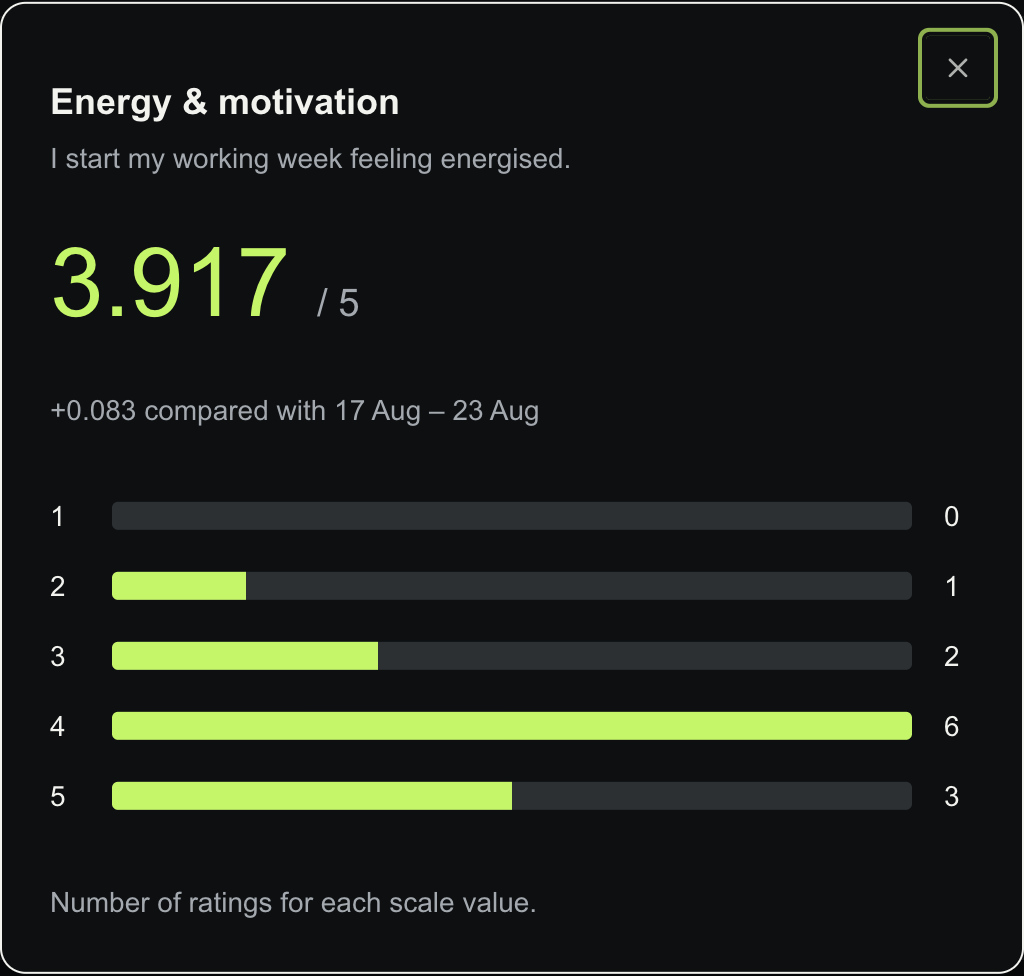
An average can quickly make topics visible. But it should not be read without reference to the question. A value of four means something different for ‘I know what takes priority’ than for ‘I am frequently interrupted’. Check whether high values point in the same substantive direction.
Avoid an overloaded first presentation. Show the questions that can lead to a decision and briefly explain the limitations. Additional detail can help when working through issues, but does not need to fill every results slide. A good overview answers: What stands out, how reliable is the observation and what do we still need to understand?
How do we read differences without interpreting too much into them?
Where possible, compare the same wording and response format over a comparable period. Check whether the group or important contextual conditions have changed. A new project phase may play a role, as may changed task allocation or longer absences.
A purely numerical example: with five ratings, if one rating changes from one to five while all others remain the same, the average increases by 0.8 points. This illustrates how strongly individual changes can affect small groups. It proves neither the cause nor a general development across the entire workforce.
Do not call differences significant without appropriate statistical testing. Even a large visible change can have several explanations. First describe the finding in plain language and name the open question. Methodological foundations for your own questions are available in Measuring employee satisfaction.
How do we handle comments?
First read comments for their content: Which work situation is described? What consequence is mentioned? What change is suggested? Separate these elements from judgements about individuals. A comment is one perspective, not automatically an objective description of everyone involved.
Do not share identifying details unnecessarily. Even without names, a particular meeting, an unusual task or a personal writing style can allow identification. For a results discussion, a carefully prepared thematic summary may be more suitable than projecting every response verbatim.
Also avoid simply counting comments as people. Several statements may come from the same person while others do not use free text at all. The number of mentions is therefore not necessarily a distribution across the workforce. Use comments to clarify topics and handle sensitive individual cases through a suitable separate channel.
How do we prioritise among several topics that stand out?
Do not sort by the lowest average alone. A low score on an issue you have little influence over may call for different next steps from a somewhat better score on a process that causes daily disruption. Consider importance, scope for influence, urgency and the available evidence together.
A simple decision framework could look like this:
| Review question | Relevance to selection |
|---|---|
| What does this issue make more difficult in practice? | Connects the finding with everyday work. |
| What do we know and what are we assuming? | Prevents assumptions from being treated as causes. |
| Can we change something ourselves? | Clarifies responsibility and decisions needed from others. |
| What would be a manageable next step? | Makes addressing the issue realistic. |
| What would be the consequences of waiting longer? | Helps set priorities without creating artificial alarm. |
Specific protection or legal issues are subject to the procedures intended for them. Addressing them should not depend on a ranking of the most popular topics. A general team score must not make a relevant individual case invisible.
How do we define an action that can be reviewed?
Record the finding, assumption, change and review separately. A fictional example: feedback on priority clarity is critical. The assumption is that conflicting assignments are not resolved in time. The change is a binding decision at the start of the week about what takes priority and which tasks are deferred.
Also name who is responsible for that decision and how unresolved conflicts are escalated. In the review, first check whether the process was actually used. Then consider suitable feedback and specific examples from work. An improved score alone does not prove a causal effect.
The following short note is often enough to start: ‘We are changing … because we suspect … . The responsible person is … . On …, we will check whether … .’ It is an original working aid, not a new documentation system. You can use it in your existing work tool.
How do we report results back to the team?
Start with the survey's purpose and the limitations of the data. Then show the selected findings without presenting a ready-made explanation as fact. Ask whether people recognise the situations described in everyday work and what information is missing to put them in context.
Then explain the next decision. Even if no action has been chosen yet, it should be clear how clarification will continue. State who is responsible and when. Avoid responses that only thank people for participating while leaving the next steps open.
When results are particularly critical, the response needs calm and commitment. The article Addressing poor check-in results explores this situation in more depth. For a regular session to work through issues, Team feedback session offers a possible process.
When is an analysis complete?
The initial analysis ends with a reasoned decision and a next step with clear responsibility. The overall process does not end there. At a later point, it must become clear whether the agreed change took place and whether the evidence supports continuing or adjusting it.
Also check whether your original question is still framed correctly. The suspected cause may have been wrong. The context may have changed. Adjusting or ending an action can therefore be a good outcome of the analysis. It is more useful than consistently positive reporting with no visible consequences.
How does EngageBeat support analysis?
EngageBeat shows team results after the week closes and with at least five valid responses per question. Trends, topics and comments can support interpretation. The tool does not replace root-cause analysis or implement actions automatically. See how it works or try it for 28 days. Your chosen paid subscription begins unless you cancel before the trial ends.
The next decision follows the analysis: Reviewing actions after an employee survey distinguishes implementation, experiences and changes in the workflow.
What common questions are there about analysis?
Should we always address the worst result first?
No. Review relevance, urgency, scope for influence and the data. The lowest average alone is not a sufficient basis for prioritisation.
May we share comments unchanged?
First review the agreed safeguards and possible inferences. Verbatim comments can make people identifiable even when they contain no names.
How many actions should we start at once?
Only as many as you can responsibly implement and review. When starting out, one clearly limited experiment is often easier to analyse than several simultaneous changes.
Sources and further background
Try it in your team
Try the path from feedback through an action to the next review with EngageBeat.
Try free for 28 days — with up to three teams. Can be ended at any time during the trial.
All terms