Employee surveys
Pulse surveys: Definition, goals and examples
A pulse survey is a short, regularly repeated survey of employees about their day-to-day work. It aims to make changes in mood, collaboration or specific working conditions visible early and support decisions on appropriate action. A single value neither explains the cause of a problem nor does a rising value prove that an action has worked.

If the team repeatedly runs into difficulties, an annual review may not be enough. The important question is then: What changes between two larger surveys, and what should we respond to now? Here you will find the basics of the format; the linked articles explore specific company examples and its use in small teams.
What exactly does pulse survey mean?
The term primarily describes the format: a few questions, a manageable reference period and recurring data collection. The content can address very different topics. The Qualtrics pulse survey guide accordingly describes pulse surveys as short, regular feedback that is not tied to one fixed set of topics.
A pulse survey is therefore a form of employee survey. It is neither automatically a comprehensive engagement measurement nor simply a spontaneous question about mood in a meeting. What matters is that the purpose, questions and handling of responses fit together across individual surveys.
A consistent core question and rotating follow-up questions can complement each other. However, to track a topic over time, you may only compare responses to the same statement under comparable conditions. Questions about clarity, support and work pressure cannot simply be joined into one continuous line.
Which goals can a pulse survey support?
One useful purpose is to reduce a leadership blind spot. For example, the team lead sees completed orders but knows little about whether backlogs can only be managed through constant improvisation. Repeated feedback on working conditions can help prepare the next decision more precisely.
- Notice changes: Are perceptions of priorities or support shifting?
- Narrow down an issue: Does the friction relate more to handovers, unclear responsibilities or missing tools?
- Follow up on actions: Is the agreed relief reaching day-to-day work?
- Keep an issue in focus: Is the new way of working actually being pursued after the launch?
This matters financially because attention and change budgets are limited. Feedback can help you avoid planning more training when what is actually missing is an approval. However, it does not replace professional assessment or operational metrics. A team may view its situation more positively while a delivery problem remains unresolved.
Which questions work as examples?
Ask about experiences employees can assess within the chosen period. The following statements are our own wording examples, rather than a scientifically validated questionnaire or a representation of a fixed product question catalogue. You could, for example, ask people to answer them on an agreement scale with every point labelled.
| Issue | Example statement | Possible decision |
|---|---|---|
| Clarity | This week, I was clear about which tasks took priority. | Set priorities more firmly. |
| Support | I could get timely support when I had difficulties. | Clarify availability and cover. |
| Workload | This week, the agreed work was manageable within the time available. | Review scope or staffing. |
| Change | This week, I knew how to apply the new process. | Adjust instructions or support. |
Clarity
- Example statement
- This week, I was clear about which tasks took priority.
- Possible decision
- Set priorities more firmly.
Support
- Example statement
- I could get timely support when I had difficulties.
- Possible decision
- Clarify availability and cover.
Workload
- Example statement
- This week, the agreed work was manageable within the time available.
- Possible decision
- Review scope or staffing.
Change
- Example statement
- This week, I knew how to apply the new process.
- Possible decision
- Adjust instructions or support.
An open follow-up can ask about a specific obstacle. Make clear that names or identifiable individual cases do not belong there. A mandatory comment is not a good substitute for a clear question: anyone who does not want to write text should not be pushed into an explanation.
As guidance for clear questions, the University of Leipzig methods portal recommends, among other things, unambiguous wording and testing the questionnaire before use. In day-to-day practice, this means asking someone to explain what they understand by a statement before you compare responses.
How often should you run a pulse survey?
The frequency should fit the pace of the topic being observed. Weekly may make sense when following short-term working conditions or an ongoing rollout. A longer interval may be appropriate for slower changes. Asking more often only helps when there is something to observe between two rounds of feedback.
Alongside the survey frequency, define the decision-making frequency too. A weekly question does not require a new action every week. Sometimes the right decision is to let an agreed change continue and assess it only after a suitable period.
After a few rounds, check whether the number of questions and the effort involved still fit. If you collect responses but do not interpret results or report back on changes, an additional survey date will not resolve the problem. Check-in or annual survey explores this trade-off in detail.
How does a signal become a useful action?
A fictional example: a dispatch team repeatedly reports difficulties managing the work. In a shared review, it becomes clear that urgent orders are only handed over shortly before the shift ends. This is a possible explanation that the team checks against specific processes; the survey value alone would not have provided it.
As a trial, the team agrees on earlier handover of urgent orders and a clear decision about exceptions. A responsible person implements the process. At the next review, the team looks both at feedback and at whether handovers are actually happening earlier.
If the assessment improves, that is an indication to investigate further. At the same time, fewer orders or different staffing may have played a role. The guiding question remains: Does our explanation still fit the day-to-day work we observe? Actions after an employee survey explores responsibilities and follow-up in more detail.
How do you read a trend without misleading yourself?
First compare question wording, reference period and the composition of the responding group. An average can change because different people took part. Holiday periods, an unusual working week or a changed question can also affect the comparison.
Alongside the value, look at the number of valid responses and, where available and safe to display, the distribution. A similar average can hide very different experiences. Small shifts need particularly cautious interpretation when responses are few; an extra decimal place does not create extra certainty.
Document important workflow changes separately from the survey value. This lets you distinguish later when an action was agreed, when it actually began and when the team first responded about it. A sequence in time makes an effect plausible to investigate, but does not yet prove causation.
Which limits and safeguards matter?
The survey captures perceptions, rather than all causes or automatically the views of every employee. Missing responses are not evidence of satisfaction. A critical value likewise does not justify searching for the people supposedly responsible for it.
Small groups, rare tasks and recognisable comments can allow inferences. A fixed minimum number alone therefore does not guarantee anonymity. Clarify in advance who receives which results, what information should be avoided and when a result should not be shown. Our Confidentiality page explains EngageBeat's protection limits; the general guidance for small teams addresses group size and day-to-day work.
Acute conflicts, discrimination or hazards need a suitable direct route for reporting and handling them. They should not wait for the next weekly value. A pulse survey complements these routes and does not replace any professionally required investigation or risk assessment.
How can you try this with EngageBeat?
EngageBeat supports short weekly check-ins and analysis at team level. The team index serves as a recurring signal; it is not a complete engagement or culture test. First use the demo to check whether the questions and presentation fit your decision.
What it looks like in the app
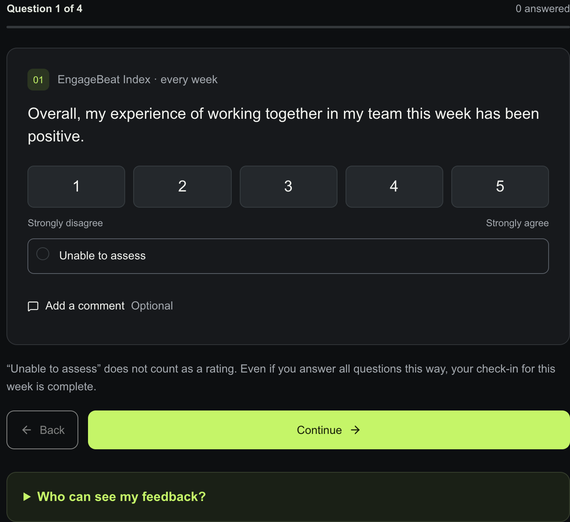
An actual check-in question
The public demo shows the fixed collaboration question, the agreement scale and the option to give no rating.
Enlarge screenshot
What questions are frequently asked about pulse surveys?
Is a pulse survey the same as an employee survey?
It is a short, regularly repeated form of employee survey. The broader term also covers more extensive, one-off or occasion-specific surveys.
Does a pulse survey have to take place weekly?
No. The interval should fit the topic, the observable pace of change and the ability to interpret results. EngageBeat uses a weekly rhythm.
How many questions belong in a pulse survey?
There is no universally applicable number. Include only questions whose responses support a specific decision and that can be answered for the chosen period.
Does a better value prove the effect of an action?
No. Workload, staffing and participation may also have changed. Use the trend alongside the work context to check your explanation.
Are small pulse surveys automatically anonymous?
No. Alongside group size, the number of responses, content, access rights and possible inferences matter. Safeguards must fit the specific use.
Sources and further background
Try it in your team
Use EngageBeat to assess whether short weekly feedback supports your team's next decision.
Try free for 28 days — with up to three teams. Can be ended at any time during the trial.
All terms