Culture & change
Measuring company culture: which methods help?
Company culture cannot be fully measured with a single number. You can, however, examine selected experiences and behaviours through surveys, conversations and observations. Repeated, unchanged questions help you see whether actions are experienced differently in everyday work.

For HR, organisational development and senior management, the key question is which decision the assessment should support. This article presents a concrete approach with our own example questions, a 1–5 scale and clear limits. It does not provide a scientifically validated culture test. If your initial focus is on specific patterns within one team, start with analysing team culture.
What can you actually measure about company culture?
The concept includes expectations, habits and assumptions about how work functions. An agreement scale can only capture part of this. The statement “I know the scope of my decisions”, for example, describes a specific experience. It does not yet explain why responsibility is distributed as it is in the company.
The CIPD evidence review on culture and organisational climate emphasises the distinction between culture as a whole and more tangibly experienced working conditions. A narrow focus is therefore advisable for your measurement. The more clearly it is defined, the easier it is to derive appropriate questions and possible actions.
If you still want to clarify which patterns shape your company, start with the overview of company culture. A repeated short survey is particularly useful when there is already a specific question about collaboration or a change.
Which methods complement one another usefully?
No single method provides the whole picture. Conversations help you understand the background. Observations show how a process actually works. Surveys make selected experiences accessible across several people. Existing business information can provide indications of specific effects.
On small screens, you can swipe the table sideways if needed to see all columns.
| Method | What it helps with | What limitation remains |
|---|---|---|
| Conversations and interviews | Understand situations and possible causes. | Individual voices are not automatically representative. |
| Observing processes | Understand decisions, handovers and routines. | Observation and interpretation must remain separate. |
| Repeated short survey | Compare experiences using unchanged questions. | Responses are perceptions; participation can change. |
| Existing process data | Add another perspective on a business problem. | A change over time does not prove a shared cause. |
Choose the combination according to the problem. If employees report a lack of clarity about priorities, also look at how tasks are assigned. You do not immediately need a large study for this. A small, transparent approach is more helpful than extensive data without a specific decision question.
What needs to be settled before a survey?
First describe the purpose in one sentence. For example: we want to know whether the new handover rule gives the team more direction. Then define who should participate, which period the responses refer to and who will interpret the results.
Also clarify how feedback will be handled: who has access? When do results become visible? What happens if there are too few responses? How will you prevent details in comments from being attributed to individuals? These questions need to be answered before the invitation, not only after critical feedback.
For the organisational framework, use the information on confidentiality and employee surveys with a works council. An analysis that is technically possible is not automatically a useful analysis. For small teams, the article on anonymity explains the limits.
Which questions fit specific culture initiatives?
The following statements are our own suggested wording. They are not part of a standardised or validated questionnaire. Choose only questions whose answers could lead to a decision. All examples refer to the past working week; you should retain this period when repeating them.
On small screens, you can swipe the table sideways if needed to see all columns.
| Initiative | Our suggested statement for a check |
|---|---|
| Clarify decision-making scope | This week, I knew which decisions I could make independently. |
| Improve handovers | During handovers this week, I had the information I needed for my task. |
| Make priorities clear | This week, I was clear about which tasks took priority. |
| Improve the handling of problems | This week, I could raise problems without having to fear negative personal consequences. |
| Make change manageable | The additional work caused by the change was manageable for me this week. |
Avoid combining several topics in one statement, such as “Management communicates well and supports us sufficiently.” A middle rating would leave it unclear which part was meant. Also avoid suggesting desired answers: “Our new, helpful handover works well” already implies an assessment.
How do you use a 1–5 scale meaningfully?
One possible agreement scale runs from 1 “strongly disagree” to 5 “strongly agree”. Give the intermediate points clear labels too, and use them consistently throughout. This lets the team know what their selection refers to.
| Response | Meaning in this example |
|---|---|
| 1 | Strongly disagree |
| 2 | Somewhat disagree |
| 3 | Partly agree, partly disagree |
| 4 | Somewhat agree |
| 5 | Strongly agree |
| Unable to assess | No relevant experience or no meaningful assessment possible |
“Unable to assess” is not a poor rating and must not enter the average as zero. If many people choose this answer, the question may not suit their everyday work. Perhaps the situation under consideration did not occur during the period.
Before starting, check the wording for clarity with a few people without asking for their rating. Is “handover” understood in the same way everywhere? Does “team” refer to the same group? This clarification improves the basis without retrospectively presenting your own questionnaire as scientifically validated.
How often should you repeat the same question?
The rhythm depends on when new experiences arise. A weekly question can suit frequent workflows. A rare decision or a long-term initiative may need longer intervals. Measurement without new experience mainly creates additional work.
Where possible, capture a baseline before changing the action. Then repeat the same wording, scale and reference period. If you refine the question, treat the new version as a new comparison series. Similar words do not guarantee identical meaning.
Alongside this, record when important events occurred: a rule was introduced, the team changed or workload was particularly high. A brief factual note is often enough. These details help with later interpretation without building personal response histories.
How do you interpret values and changes?
First look at the data basis. How many valid responses are available, and has the period ended? When participation changes, a difference may also result from a different composition of responses. An average also hides whether experiences are similar or very different.
A fictional calculation: a statement is initially rated 3.0 and later 3.6. That is a change of 0.6 scale points. It does not follow that company culture has improved by a corresponding percentage. An agreement scale is not a ratio measure of culture quality.
Avoid inventing general traffic-light thresholds such as “a score of 4 or above means the culture is healthy”. Instead, examine the specific initiative, recurring patterns and additional observations. Values can be unstable when there are very few responses; missing values must not be interpreted as agreement or disagreement.
How do you check whether an action helped?
Compare the feedback with the expected mechanism. If the action was intended to clarify decisions, ask about perceived clarity and also look at actual approvals. Better general mood only answers this specific question indirectly.
Even when the trend fits, the cause remains open. Perhaps staffing increased at the same time, or a demanding project ended. Document such changes and word your conclusion with corresponding care: the observations suggest an improvement; they do not prove that the action alone was responsible.
Use this to make a decision: continue, adjust, investigate further or stop. Record an owner and the next review point. For the wider context, culture change in companies shows how this feedback can inform the management of several initiatives.
What does a repeated question look like in EngageBeat?
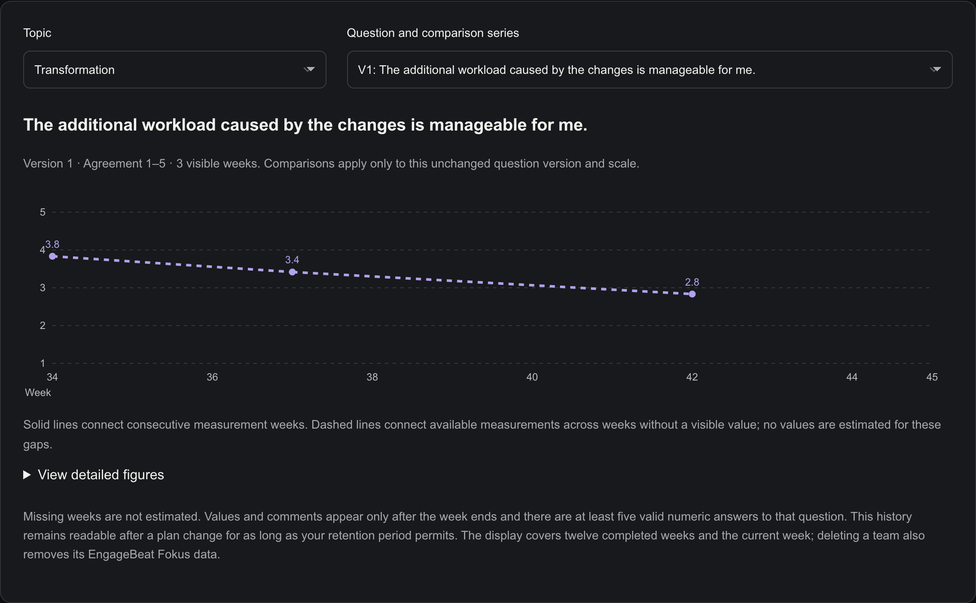
EngageBeat Fokus shows trends for individual statements separately from the fixed team index. The demo screenshot below looks at how manageable a change is perceived to be on a 1–5 scale. It contains only fictional example data. Weeks without a visible value are not estimated measurements.
With EngageBeat Team, you track mood and motivation; with EngageBeat Fokus, you add custom questions about your actions. This keeps initiatives present and makes indications of necessary adjustments visible. The app does not replace a complete culture analysis or proof of causation. With “Set up for free”, you can explore how the process fits your team.
For a clearly defined change initiative, measuring change management helps you distinguish implementation, experiences and business outcomes.
What it looks like in the app
Track a specific experience over several measurement weeks
The unchanged statement is considered separately from the team index. Dashed connections bridge weeks without a visible value; no values are estimated for these gaps.
Enlarge screenshot
What questions are frequently asked?
Is there one correct culture questionnaire?
No. Different methods examine different aspects. For a scientific assessment, the instrument and its area of use need to fit together. The examples on this page are practical suggestions, not a validated culture test.
Can teams be compared using their culture scores?
This is only useful with considerable caution. Tasks, participation and conditions can differ. A ranking can create the wrong incentives. For specific actions, the development of each team is often more helpful.
Does mood have to improve immediately after an action?
No. Some changes take time; others do not work as expected. More open feedback can initially make problems clearer. Review the trend together with participation, implementation and business events.
Sources and further background
Try it in your team
Try custom questions on specific changes with EngageBeat Fokus without deriving a general culture score from them.
Try free for 28 days — with up to three teams. Can be ended at any time during the trial.
All terms