Change
How can team questions help assess AI adoption?
AI adoption in a team can be assessed usefully by focusing on a specific use case and asking separately about usefulness, confidence in using it and actual application. General approval of AI says little about whether a tool is being used helpfully in everyday work. Combined with appropriate observations of work, answers can point to next steps in implementation.

A survey does not need to explain everything. It can reveal where support is missing or which assumption needs closer examination. What matters is being able to derive a specific decision from the answers, rather than simply seeking the most positive overall score possible.
What exactly do you mean by AI adoption?
Before asking the first question, clarify which change you mean. Is it about getting to know an approved tool, applying it to a particular task or permanently changing a workflow? These situations require different questions.
Even the word 'AI' is too broad if everyone has something different in mind. Summarising internal notes is a different application from drafting customer communications. Refer to a named use case and explain which task you mean during the period being considered.
If the tool or area of use changes during observation, record that. Otherwise, a shift in answers may appear to reflect acceptance when a different task was actually being assessed. Comparability comes from a clear reference point, rather than simply repeating the same heading.
Why is asking about general attitudes not enough?
A positive attitude can coincide with little use. There may have been no suitable task, access may have been missing or the rules unclear. Conversely, frequent use can involve substantial reworking. These observations answer different questions.
A broad question about whether AI makes sense invites a general opinion. When shaping implementation, it is often more important to know which specific obstacle currently exists. A focused question makes it easier to choose appropriate support.
This does not mean attitudes are unimportant. They should simply not be treated as a complete picture of implementation. State what the answers actually refer to in the report. Avoid inventing an overall index that combines different topics without a clear rationale.
Which questions show perceived usefulness?
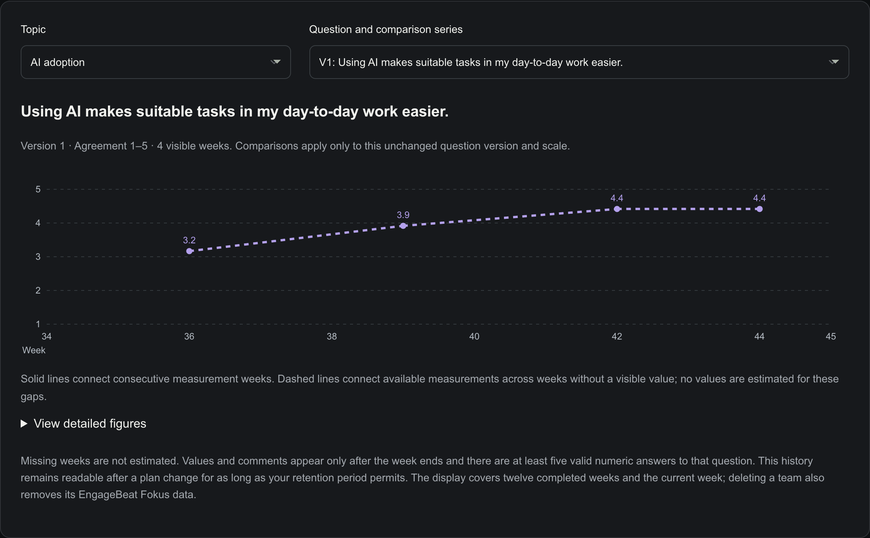
One statement in the AI adoption topic pack is: 'Using AI makes suitable tasks in my day-to-day work easier.' It captures perceived usefulness in daily work. Whether outputs are professionally usable needs to be checked separately against specific work steps; this question alone does not measure output quality.
Choose questions from the topic pack whose answers you need for the next decision. Also clarify whether everyone had an opportunity to gain experience during the period. Someone who has not used the tool should not have to give an assessment that appears to be based on experience.
The questions come from the EngageBeat Fokus topic pack. They are not a scientifically validated scale. They can support discussion of obstacles, but do not prove time savings. To assess that kind of benefit, you also need an appropriate examination of the specific workflow.
Which questions show clarity and opportunities to learn?
Knowing the approved tools and having time to learn can be crucial to implementation. The topic pack includes: 'I know which AI tools I am allowed to use for my work.' And: 'I have enough opportunities to learn how to use AI safely.'
These statements address different prerequisites: clarity about tool approval and opportunities to learn. Neither measures individual skills or knowledge of every permitted type of data input. Keeping them separate helps you select appropriate support.
A survey result does not replace binding rules for tool use. Where rules are missing, the responsible parties first need to clarify them. Feedback can reveal that need. It does not determine which data or applications are legally permitted.
What it looks like in the app
What specifically is observed in AI adoption?
This example asks whether AI makes suitable day-to-day tasks easier. The unchanged statement is reviewed repeatedly; the values alone do not establish a cause.
Enlarge screenshot
How do you ask about use without drawing false conclusions?
Start with the opportunity to use it: Was there actually a task suited to the agreed application? Only then does it make sense to ask whether the tool was used. This avoids interpreting a lack of opportunity as rejection.
The topic pack includes the statement: 'We can openly discuss obstacles to using AI in our team.' It captures whether barriers can be discussed. Optional comments can explain specific obstacles. Ask people not to include confidential tool content, customer data or sensitive individual cases.
The purpose is to understand working conditions and improve support. A survey should not be used to covertly monitor individual performance. Define in advance how feedback will be analysed and which uses are excluded. Confidentiality and co-determination help with the organisational framework.
How do you translate answers into a suitable measure?
Hypothetical example: A team sees potential benefits but is still unsure which tools are approved. Another general talk about AI's opportunities only partly addresses that obstacle. A practical guide with approved examples and a named contact might be more helpful.
After introducing it, the team checks whether the guide was understandable and used in suitable situations. It then revisits the same statement about clarity on approved tools. Record the expectation before starting so that later interpretation is not arbitrary.
If the obstacle instead concerns output quality, a different measure is needed. The use case may need to be narrowed or the tool used differently. General training is not automatically the answer to every difficulty. The measure should fit the specific situation described.
How can changes over time be interpreted?
Keep relevant questions, scales and reference periods as stable as possible. Record changes to the tool, task, rules or team composition. This information helps you interpret later differences cautiously. A new question should not be attached to an old trend without explanation.
First check whether the measure was implemented. If a guide was hardly used, unchanged feedback tells you little about its suitability in principle. If it was used and the experience improved, that is an indication you can continue to observe.
Other influences are possible too. Tasks may have become easier, or use may temporarily have received particularly close support. Describe these conditions rather than claiming a clear cause-and-effect relationship. Record implementation, observed changes and other possible influences separately. Then agree whether to retain the measure, adapt it or continue observing.
Which common questions can be misleading?
Statements containing several parts are difficult to analyse. Asking about frequent use, faster work and safety all at once mixes application, usefulness and safety. One answer does not show which part was meant. Separate the aspects or focus on the decision that matters most right now.
Also avoid judgemental questions demanding that people finally become more open to AI. They imply a preferred attitude and make honest feedback harder. Ask about experience and obstacles rather than categorising people as progressive or behind the times.
A general question about time saved can also be problematic if tasks vary greatly or nobody has a meaningful comparison. Do not claim precision the answer cannot support. A specific account of what became easier or harder may be more useful for the next step.
How do you start with a manageable set of questions?
Choose the use case, name the upcoming decision and check that the conditions for permitted use are clear. Then formulate only questions whose answers you can use for that decision. A short framework is better than a broad catalogue without an obvious purpose.
Agree in advance who will interpret feedback and when possible changes will be decided. Afterwards, explain which measure you chose or why you are continuing to observe for now. This makes the survey's purpose understandable.
Further methodological guidance is available in pulse surveys in small teams and the sample questions. The most important test remains whether the question fits your actual working day.
What questions are frequently asked about this?
Does frequent use prove that implementation is successful?
No. Use initially shows application. Whether it is helpful and appropriate must be considered in the context of the specific use case.
Can a survey replace missing rules?
No. It can reveal uncertainty. The responsible parties must establish binding rules for permitted use.
Are the suggested questions scientifically validated?
No. The statements shown here come from the AI topic pack in EngageBeat Fokus. They support interpretation but are not a scientifically validated instrument for measuring AI adoption.
How does EngageBeat support observation?
EngageBeat Fokus enables custom questions and topics on AI adoption. How it works explains separate topic trends and question versions. This lets you track feedback on implementation and adjust measures deliberately, without implying automatic guarantees of success.
Further reading: choose suitable AI applications for everyday work.
After training, interpretation needs a different focus: reviewing learning transfer after AI training shows how to examine application and further support needs.
Try it in your team
Try EngageBeat Fokus to see which feedback helps with your next decision on introducing AI.
Try free for 28 days — with up to three teams. Can be ended at any time during the trial.
All terms