Practice
Pulse surveys in small teams: what makes sense?
A pulse survey in a small team works when it repeats a few specific questions, explains the limits of confidentiality and leads to understandable decisions. It can help you observe changes in everyday work and adjust measures. It does not replace resolving sensitive individual cases or comprehensively assessing all working conditions.

The closeness of a small team is both an advantage and a challenge. Feedback can quickly be connected to a specific workflow. At the same time, people know each other well and may draw inferences from comments. A short check therefore needs a clear framework, even if completing it is simple. Pulse surveys: definition, goals and examples explains the format's main characteristics.
Which question should you clarify before the first survey?
Start with the purpose. Which decision do you want feedback to help you make? General curiosity about mood is not enough if nobody knows what will happen to the results afterwards. Suitable topics include priorities, handovers or how clearly a new working rule is understood.
Express the purpose so that the team can see its influence: 'We want to check whether our new handover gives you enough guidance.' This does not imply that a particular answer is expected. It simply makes clear which experience you are examining and what kind of change could follow.
Also clarify whether you can take action yourselves. If a topic needs decisions outside the team, name the responsible party. A check should not replace raising an already known obstacle now. Repeated questions without a way to deal with the answers may provide little additional guidance.
Which statements are useful to repeat?
Clear statements about a specific experience during the period in question work well. 'It was clear to me which task took priority' is easier to interpret than 'Our organisation is good.' The narrower focus makes it easier to consider what could change later.
Keep each statement to one idea. Wording that combines clarity, appreciation and workload leaves it unclear which part drives the answer. Use an understandable scale and explain what the assessment should refer to. The sample questions offer practical ideas.
To track a trend, the relevant question must recur. If the wording or meaning changes, you are methodologically starting a new series. Constant variety may seem interesting, but it makes a particular topic's development harder to see. Additional questions should not completely displace a stable reference point.
How short can a check be without becoming arbitrary?
Short means matching the scope to the decision. One question can illuminate a narrow aspect. It cannot comprehensively explain workload, motivation, leadership, trust and collaboration all at once. The less you ask, the more important it is to be precise about what the answer tells you.
Do not plan a fixed number of questions merely because a tool allows it. Check whether every statement has a recognisable purpose. Questions with no intended use can be left out. An optional comment field can add context, but needs a clear explanation of how to handle sensitive details.
Even a very short check needs an introduction. The team should know who sees results, when reporting becomes available and what is planned afterwards. This explanation is part of the process. It should not arrive only after the first critical response.
What it looks like in the app
What does a short check-in look like?
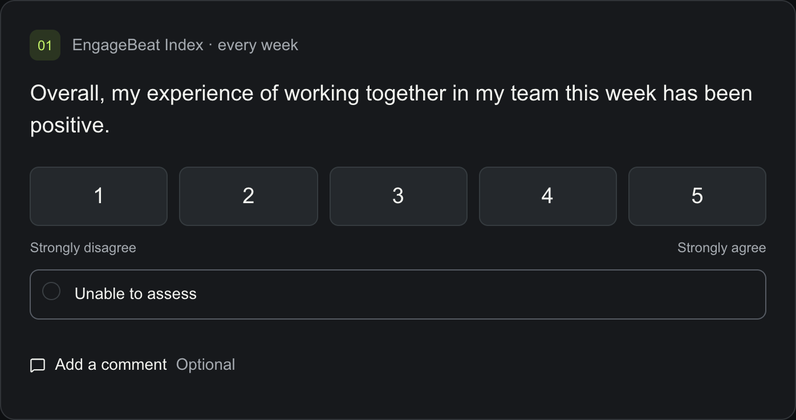
A clear statement and a response scale from 1 to 5. Anyone unable to assess the statement has a separate response option.
Enlarge screenshot
How does a small team size affect interpretation?
In small groups, a change in participation can visibly affect the overall value. If different people answer this time, you may be comparing different perspectives as well as different weeks. Look at participation alongside the trend.
Avoid unnecessary subdivisions. Breaking results down by role or working hours can make an already small group even smaller. It does not automatically generate better insights. Consider whether the planned decision can also be made by looking at the group as a whole.
Sufficient anonymity cannot be determined from a number alone. Free text and knowledge from everyday work remain relevant. How many people make an employee survey anonymous? explains the connections. Safeguards should be defined before the invitation and remain dependable throughout the process.
How do you find a suitable frequency?
Choose a frequency at which the experience being examined can genuinely occur again and you can work with the results. Recurring tasks are easier to review regularly than long-term changes whose development becomes visible only after a longer period.
A calendar alone does not make a survey useful. If a question does not apply to many people during the period, it needs a suitable response option or different timing. Forcing a rating without relevant experience can make the result difficult to interpret.
Plan the review alongside the questions. Collecting results without interpreting them for a long time does not create a reliable working process. Check-in or annual survey helps you choose between short regular checks and a broader format.
What should you do about a noticeable change?
Treat a noticeable development as a signal first. Check whether the question, participation or work context has changed. Only then does it make sense to consider which explanation is plausible. A single value is not a ready-made action plan.
Hypothetical example: A team finds its priorities increasingly unclear. During review, it emerges that new assignments arrive from several different sources. The team agrees one clear route for changing priorities. It then observes whether that route is used and whether everyday work becomes easier to navigate.
This approach connects feedback with a specific change. It does not mean that the question alone has proved the cause. Record the assumption separately from the measure. Note the specific change, a responsible person and the next review date.
What often works poorly in a small team?
A check that covertly seeks someone to blame for dissatisfaction is problematic. General target scores used to judge every team regardless of its situation are no more helpful. A decline should prompt interpretation, rather than automatically require people to justify themselves.
Starting too many measures at the same time also makes follow-up harder. If something changes afterwards, it remains unclear which step might have contributed. A manageable experiment with clear responsibility is often easier to review than a large bundle of non-binding intentions.
Another boundary is confusion with individual performance measurement. A mood snapshot describes experienced conditions and collaboration. It is unsuitable for ranking individuals by their value to the company. Make this distinction both in the introduction and in the later use of results.
How should you handle low participation?
If little feedback comes in, do not start looking for individual non-participants. First check whether the purpose, response window and access method are clear. There may have been no suitable opportunity, or the questions may have concerned experiences not everyone has had.
Also explain what followed from the survey so far. That may be a specific change, or a reasoned decision not to implement something for the time being. Making the response to answers visible is different from promising to fulfil every wish.
If participation remains insufficient, review the format. It may need a clearer introduction, a different question or initially another way to clarify the issue. Do not lower a protection threshold afterwards simply to produce a report. Unavailable results are more honest than results whose claimed protection is misleading.
How can you tell whether the check is useful to you?
A useful check supports understandable decisions. You can name the question being examined, what was observed and which next step follows. A new measure does not have to emerge every week. A reasoned decision to keep observing can make sense too.
Review the effort involved in participation and reporting. If you collect a lot of data but use little of it, simplify the process. If important distinctions are missing, make questions more precise. What matters is the fit with the task, rather than the largest possible collection of metrics.
Consider confidentiality and, where relevant, co-determination from the start. A sound survey method also needs an appropriate organisational framework. The following answers cover common concerns at the outset.
What questions are frequently asked about this?
Does every check need to lead to a new measure?
No. Results can add to an existing assessment or show a need for further observation. What matters is handling them in a way people can understand.
Can one value represent the team's motivation?
Only to a very limited extent. A value relates to the question asked and the period considered. It explains neither all conditions nor their causes.
What if results are not released?
Maintain the previously defined safeguard. Then consider whether the introduction, question or format needs to fit the group better.
How can you try this with EngageBeat?
EngageBeat is designed for short weekly team check-ins. How it works explains the fixed index and separate topic trends; the demo shows an example using sample data. Interpreting results and choosing suitable measures remain your responsibility.
Further reading: explore a feedback tool for regular team checks.
Try it in your team
Try a short weekly rhythm with EngageBeat, taking your small team's privacy thresholds into account.
Try free for 28 days — with up to three teams. Can be ended at any time during the trial.
All terms